#!/usr/bin/env python
# coding: utf-8
# Summary of my results:
#
# model | train_loss | valid_loss | seq2seq_acc | bleu
# -------------------|----------|----------|----------|----------
# seq2seq | 3.355085 | 4.272877 | 0.382089 | 0.291899
# \+ teacher forcing | 3.154585 | 4.022432 | 0.407792 | 0.310715
# \+ attention | 1.452292 | 3.420485 | 0.498205 | 0.413232
# transformer | 1.913152 | 2.349686 | 0.781749 | 0.612880
# # Translation with an RNN
# This notebook is modified from [this one](https://github.com/fastai/fastai_docs/blob/master/dev_course/dl2/translation.ipynb) created by Sylvain Gugger.
#
# Today we will be tackling the task of translation. We will be translating from French to English, and to keep our task a manageable size, we will limit ourselves to translating questions.
#
# This task is an example of sequence to sequence (seq2seq). Seq2seq can be more challenging than classification, since the output is of variable length (and typically different from the length of the input.
# French/English parallel texts from http://www.statmt.org/wmt15/translation-task.html . It was created by Chris Callison-Burch, who crawled millions of web pages and then used *a set of simple heuristics to transform French URLs onto English URLs (i.e. replacing "fr" with "en" and about 40 other hand-written rules), and assume that these documents are translations of each other*.
# Translation is much tougher in straight PyTorch: https://pytorch.org/tutorials/intermediate/seq2seq_translation_tutorial.html
# In[1]:
from fastai.text import *
# ## Download and preprocess our data
# We will start by reducing the original dataset to questions. You only need to execute this once, uncomment to run. The dataset can be downloaded [here](https://s3.amazonaws.com/fast-ai-nlp/giga-fren.tgz).
# In[2]:
path = Config().data_path()
# In[3]:
# ! wget https://s3.amazonaws.com/fast-ai-nlp/giga-fren.tgz -P {path}
# In[4]:
# ! tar xf {path}/giga-fren.tgz -C {path}
# In[3]:
path = Config().data_path()/'giga-fren'
path.ls()
# In[6]:
# with open(path/'giga-fren.release2.fixed.fr') as f: fr = f.read().split('\n')
# In[7]:
# with open(path/'giga-fren.release2.fixed.en') as f: en = f.read().split('\n')
# We will use regex to pick out questions by finding the strings in the English dataset that start with "Wh" and end with a question mark. You only need to run these lines once:
# In[8]:
# re_eq = re.compile('^(Wh[^?.!]+\?)')
# re_fq = re.compile('^([^?.!]+\?)')
# en_fname = path/'giga-fren.release2.fixed.en'
# fr_fname = path/'giga-fren.release2.fixed.fr'
# In[9]:
# lines = ((re_eq.search(eq), re_fq.search(fq))
# for eq, fq in zip(open(en_fname, encoding='utf-8'), open(fr_fname, encoding='utf-8')))
# qs = [(e.group(), f.group()) for e,f in lines if e and f]
# In[10]:
# qs = [(q1,q2) for q1,q2 in qs]
# df = pd.DataFrame({'fr': [q[1] for q in qs], 'en': [q[0] for q in qs]}, columns = ['en', 'fr'])
# df.to_csv(path/'questions_easy.csv', index=False)
# In[11]:
path.ls()
# ## Load our data into a DataBunch
# Our questions look like this now:
# In[4]:
df = pd.read_csv(path/'questions_easy.csv')
df.head()
# To make it simple, we lowercase everything.
# In[5]:
df['en'] = df['en'].apply(lambda x:x.lower())
df['fr'] = df['fr'].apply(lambda x:x.lower())
# The first thing is that we will need to collate inputs and targets in a batch: they have different lengths so we need to add padding to make the sequence length the same;
# In[7]:
def seq2seq_collate(samples, pad_idx=1, pad_first=True, backwards=False):
"Function that collect samples and adds padding. Flips token order if needed"
samples = to_data(samples)
max_len_x,max_len_y = max([len(s[0]) for s in samples]),max([len(s[1]) for s in samples])
res_x = torch.zeros(len(samples), max_len_x).long() + pad_idx
res_y = torch.zeros(len(samples), max_len_y).long() + pad_idx
if backwards: pad_first = not pad_first
for i,s in enumerate(samples):
if pad_first:
res_x[i,-len(s[0]):],res_y[i,-len(s[1]):] = LongTensor(s[0]),LongTensor(s[1])
else:
res_x[i,:len(s[0]):],res_y[i,:len(s[1]):] = LongTensor(s[0]),LongTensor(s[1])
if backwards: res_x,res_y = res_x.flip(1),res_y.flip(1)
return res_x,res_y
# Then we create a special `DataBunch` that uses this collate function.
# In[8]:
doc(Dataset)
# In[9]:
doc(DataLoader)
# In[6]:
doc(DataBunch)
# In[20]:
class Seq2SeqDataBunch(TextDataBunch):
"Create a `TextDataBunch` suitable for training an RNN classifier."
@classmethod
def create(cls, train_ds, valid_ds, test_ds=None, path:PathOrStr='.', bs:int=32, val_bs:int=None, pad_idx=1,
dl_tfms=None, pad_first=False, device:torch.device=None, no_check:bool=False, backwards:bool=False, **dl_kwargs) -> DataBunch:
"Function that transform the `datasets` in a `DataBunch` for classification. Passes `**dl_kwargs` on to `DataLoader()`"
datasets = cls._init_ds(train_ds, valid_ds, test_ds)
val_bs = ifnone(val_bs, bs)
collate_fn = partial(seq2seq_collate, pad_idx=pad_idx, pad_first=pad_first, backwards=backwards)
train_sampler = SortishSampler(datasets[0].x, key=lambda t: len(datasets[0][t][0].data), bs=bs//2)
train_dl = DataLoader(datasets[0], batch_size=bs, sampler=train_sampler, drop_last=True, **dl_kwargs)
dataloaders = [train_dl]
for ds in datasets[1:]:
lengths = [len(t) for t in ds.x.items]
sampler = SortSampler(ds.x, key=lengths.__getitem__)
dataloaders.append(DataLoader(ds, batch_size=val_bs, sampler=sampler, **dl_kwargs))
return cls(*dataloaders, path=path, device=device, collate_fn=collate_fn, no_check=no_check)
# In[ ]:
get_ipython().run_line_magic('pinfo2', 'SortishSampler')
# And a subclass of `TextList` that will use this `DataBunch` class in the call `.databunch` and will use `TextList` to label (since our targets are other texts).
# In[21]:
class Seq2SeqTextList(TextList):
_bunch = Seq2SeqDataBunch
_label_cls = TextList
# Thats all we need to use the data block API!
# In[22]:
src = Seq2SeqTextList.from_df(df, path = path, cols='fr').split_by_rand_pct(seed=42).label_from_df(cols='en', label_cls=TextList)
# In[23]:
np.percentile([len(o) for o in src.train.x.items] + [len(o) for o in src.valid.x.items], 90)
# In[24]:
np.percentile([len(o) for o in src.train.y.items] + [len(o) for o in src.valid.y.items], 90)
# We remove the items where one of the target is more than 30 tokens long.
# In[25]:
src = src.filter_by_func(lambda x,y: len(x) > 30 or len(y) > 30)
# In[26]:
len(src.train) + len(src.valid)
# In[27]:
data = src.databunch()
# In[28]:
data.save()
# In[29]:
data
# In[30]:
path
# In[31]:
data = load_data(path)
# In[32]:
data.show_batch()
# ## Create our Model
# ### Pretrained embeddings
# You will need to download the word embeddings (crawl vectors) from the fastText docs. FastText has [pre-trained word vectors](https://fasttext.cc/docs/en/crawl-vectors.html) for 157 languages, trained on Common Crawl and Wikipedia. These models were trained using CBOW.
#
# If you need a refresher on word embeddings, you can check out my gentle intro in [this word embedding workshop](https://www.youtube.com/watch?v=25nC0n9ERq4&list=PLtmWHNX-gukLQlMvtRJ19s7-8MrnRV6h6&index=10&t=0s) with accompanying [github repo](https://github.com/fastai/word-embeddings-workshop).
#
# More reading on CBOW (Continuous Bag of Words vs. Skip-grams):
#
# - [fastText tutorial](https://fasttext.cc/docs/en/unsupervised-tutorial.html#advanced-readers-skipgram-versus-cbow)
# - [StackOverflow](https://stackoverflow.com/questions/38287772/cbow-v-s-skip-gram-why-invert-context-and-target-words)
# To install fastText:
# ```
# $ git clone https://github.com/facebookresearch/fastText.git
# $ cd fastText
# $ pip install .
# ```
# In[33]:
import fastText as ft
# The lines to download the word vectors only need to be run once:
# In[60]:
# ! wget https://dl.fbaipublicfiles.com/fasttext/vectors-crawl/cc.en.300.bin.gz -P {path}
# ! wget https://dl.fbaipublicfiles.com/fasttext/vectors-crawl/cc.fr.300.bin.gz -P {path}
# In[61]:
# gunzip {path} / cc.en.300.bin.gz
# gunzip {path} / cc.fr.300.bin.gz
# In[34]:
fr_vecs = ft.load_model(str((path/'cc.fr.300.bin')))
en_vecs = ft.load_model(str((path/'cc.en.300.bin')))
# We create an embedding module with the pretrained vectors and random data for the missing parts.
# In[35]:
def create_emb(vecs, itos, em_sz=300, mult=1.):
emb = nn.Embedding(len(itos), em_sz, padding_idx=1)
wgts = emb.weight.data
vec_dic = {w:vecs.get_word_vector(w) for w in vecs.get_words()}
miss = []
for i,w in enumerate(itos):
try: wgts[i] = tensor(vec_dic[w])
except: miss.append(w)
return emb
# In[36]:
emb_enc = create_emb(fr_vecs, data.x.vocab.itos)
emb_dec = create_emb(en_vecs, data.y.vocab.itos)
# In[37]:
emb_enc.weight.size(), emb_dec.weight.size()
# In[38]:
model_path = Config().model_path()
# In[39]:
torch.save(emb_enc, model_path/'fr_emb.pth')
torch.save(emb_dec, model_path/'en_emb.pth')
# In[40]:
emb_enc = torch.load(model_path/'fr_emb.pth')
emb_dec = torch.load(model_path/'en_emb.pth')
# ## Our Model
# Review Question: What are the two types of numbers in deep learning?
# ### Encoders & Decoders
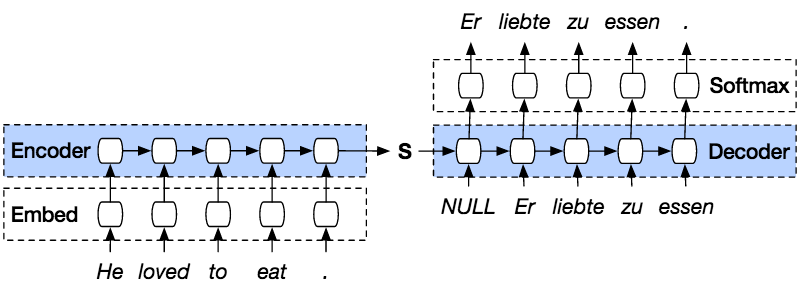
# The model in itself consists in an encoder and a decoder
#
# 
#
# Diagram from Smerity's Peeking into the neural network architecture used for Google's Neural Machine Translation
#
# The encoder is a recurrent neural net and we feed it our input sentence, producing an output (that we discard for now) and a hidden state. A **hidden state** is the activations that come out of an RNN.
#
# That hidden state is then given to the decoder (an other RNN) which uses it in conjunction with the outputs it predicts to get produce the translation. We loop until the decoder produces a padding token (or at 30 iterations to make sure it's not an infinite loop at the beginning of training).
# We will use a GRU for our encoder and a separate GRU for our decoder. Other options are to use LSTMs or QRNNs (see here). GRUs, LSTMs, and QRNNs all solve the problem of how RNNs can lack long-term memory.
#
# Links:
# - [Illustrated Guide to LSTM’s and GRU’s: A step by step explanation](https://towardsdatascience.com/illustrated-guide-to-lstms-and-gru-s-a-step-by-step-explanation-44e9eb85bf21)
# - [fast.ai implementation of seq2seq with QRNNs](https://github.com/fastai/fastai_docs/blob/master/dev_course/dl2/translation.ipynb)
# In[43]:
class Seq2SeqRNN(nn.Module):
def __init__(self, emb_enc, emb_dec,
nh, out_sl,
nl=2, bos_idx=0, pad_idx=1):
super().__init__()
self.nl,self.nh,self.out_sl = nl,nh,out_sl
self.bos_idx,self.pad_idx = bos_idx,pad_idx
self.em_sz_enc = emb_enc.embedding_dim
self.em_sz_dec = emb_dec.embedding_dim
self.voc_sz_dec = emb_dec.num_embeddings
self.emb_enc = emb_enc
self.emb_enc_drop = nn.Dropout(0.15)
self.gru_enc = nn.GRU(self.em_sz_enc, nh, num_layers=nl,
dropout=0.25, batch_first=True)
self.out_enc = nn.Linear(nh, self.em_sz_dec, bias=False)
self.emb_dec = emb_dec
self.gru_dec = nn.GRU(self.em_sz_dec, self.em_sz_dec, num_layers=nl,
dropout=0.1, batch_first=True)
self.out_drop = nn.Dropout(0.35)
self.out = nn.Linear(self.em_sz_dec, self.voc_sz_dec)
self.out.weight.data = self.emb_dec.weight.data
def encoder(self, bs, inp):
h = self.initHidden(bs)
emb = self.emb_enc_drop(self.emb_enc(inp))
_, h = self.gru_enc(emb, h)
h = self.out_enc(h)
return h
def decoder(self, dec_inp, h):
emb = self.emb_dec(dec_inp).unsqueeze(1)
outp, h = self.gru_dec(emb, h)
outp = self.out(self.out_drop(outp[:,0]))
return h, outp
def forward(self, inp):
bs, sl = inp.size()
h = self.encoder(bs, inp)
dec_inp = inp.new_zeros(bs).long() + self.bos_idx
res = []
for i in range(self.out_sl):
h, outp = self.decoder(dec_inp, h)
dec_inp = outp.max(1)[1]
res.append(outp)
if (dec_inp==self.pad_idx).all(): break
return torch.stack(res, dim=1)
def initHidden(self, bs): return one_param(self).new_zeros(self.nl, bs, self.nh)
# In[44]:
xb,yb = next(iter(data.valid_dl))
# In[45]:
xb.shape
# In[46]:
rnn = Seq2SeqRNN(emb_enc, emb_dec, 256, 30)
# In[47]:
rnn
# In[48]:
len(xb[0])
# In[51]:
h = rnn.encoder(64, xb.cpu())
# In[52]:
h.size()
# The loss pads output and target so that they are of the same size before using the usual flattened version of cross entropy. We do the same for accuracy.
# In[53]:
def seq2seq_loss(out, targ, pad_idx=1):
bs,targ_len = targ.size()
_,out_len,vs = out.size()
if targ_len>out_len: out = F.pad(out, (0,0,0,targ_len-out_len,0,0), value=pad_idx)
if out_len>targ_len: targ = F.pad(targ, (0,out_len-targ_len,0,0), value=pad_idx)
return CrossEntropyFlat()(out, targ)
# ## Train our model
# In[54]:
learn = Learner(data, rnn, loss_func=seq2seq_loss)
# In[55]:
learn.lr_find()
# In[56]:
learn.recorder.plot()
# In[57]:
learn.fit_one_cycle(4, 1e-2)
# Let's free up some RAM
# In[58]:
del fr_vecs
del en_vecs
# As loss is not very interpretable, let's also look at the accuracy. Again, we will add padding so that the output and target are of the same length.
# In[59]:
def seq2seq_acc(out, targ, pad_idx=1):
bs,targ_len = targ.size()
_,out_len,vs = out.size()
if targ_len>out_len: out = F.pad(out, (0,0,0,targ_len-out_len,0,0), value=pad_idx)
if out_len>targ_len: targ = F.pad(targ, (0,out_len-targ_len,0,0), value=pad_idx)
out = out.argmax(2)
return (out==targ).float().mean()
# ### Bleu metric (see dedicated notebook)
# In translation, the metric usually used is BLEU.
#
# A great post by Rachael Tatman: [Evaluating Text Output in NLP: BLEU at your own risk](https://towardsdatascience.com/evaluating-text-output-in-nlp-bleu-at-your-own-risk-e8609665a213)
# In[60]:
class NGram():
def __init__(self, ngram, max_n=5000): self.ngram,self.max_n = ngram,max_n
def __eq__(self, other):
if len(self.ngram) != len(other.ngram): return False
return np.all(np.array(self.ngram) == np.array(other.ngram))
def __hash__(self): return int(sum([o * self.max_n**i for i,o in enumerate(self.ngram)]))
# In[61]:
def get_grams(x, n, max_n=5000):
return x if n==1 else [NGram(x[i:i+n], max_n=max_n) for i in range(len(x)-n+1)]
# In[62]:
def get_correct_ngrams(pred, targ, n, max_n=5000):
pred_grams,targ_grams = get_grams(pred, n, max_n=max_n),get_grams(targ, n, max_n=max_n)
pred_cnt,targ_cnt = Counter(pred_grams),Counter(targ_grams)
return sum([min(c, targ_cnt[g]) for g,c in pred_cnt.items()]),len(pred_grams)
# In[63]:
class CorpusBLEU(Callback):
def __init__(self, vocab_sz):
self.vocab_sz = vocab_sz
self.name = 'bleu'
def on_epoch_begin(self, **kwargs):
self.pred_len,self.targ_len,self.corrects,self.counts = 0,0,[0]*4,[0]*4
def on_batch_end(self, last_output, last_target, **kwargs):
last_output = last_output.argmax(dim=-1)
for pred,targ in zip(last_output.cpu().numpy(),last_target.cpu().numpy()):
self.pred_len += len(pred)
self.targ_len += len(targ)
for i in range(4):
c,t = get_correct_ngrams(pred, targ, i+1, max_n=self.vocab_sz)
self.corrects[i] += c
self.counts[i] += t
def on_epoch_end(self, last_metrics, **kwargs):
precs = [c/t for c,t in zip(self.corrects,self.counts)]
len_penalty = exp(1 - self.targ_len/self.pred_len) if self.pred_len < self.targ_len else 1
bleu = len_penalty * ((precs[0]*precs[1]*precs[2]*precs[3]) ** 0.25)
return add_metrics(last_metrics, bleu)
# ### Training with metrics
# In[64]:
learn = Learner(data, rnn, loss_func=seq2seq_loss, metrics=[seq2seq_acc, CorpusBLEU(len(data.y.vocab.itos))])
# In[65]:
learn.lr_find()
# In[66]:
learn.recorder.plot()
# In[67]:
learn.fit_one_cycle(4, 1e-2)
# In[ ]:
learn.fit_one_cycle(4, 1e-3)
# So how good is our model? Let's see a few predictions.
# In[68]:
def get_predictions(learn, ds_type=DatasetType.Valid):
learn.model.eval()
inputs, targets, outputs = [],[],[]
with torch.no_grad():
for xb,yb in progress_bar(learn.dl(ds_type)):
out = learn.model(xb)
for x,y,z in zip(xb,yb,out):
inputs.append(learn.data.train_ds.x.reconstruct(x))
targets.append(learn.data.train_ds.y.reconstruct(y))
outputs.append(learn.data.train_ds.y.reconstruct(z.argmax(1)))
return inputs, targets, outputs
# In[88]:
inputs, targets, outputs = get_predictions(learn)
# In[89]:
inputs[700], targets[700], outputs[700]
# In[90]:
inputs[701], targets[701], outputs[701]
# In[91]:
inputs[2513], targets[2513], outputs[2513]
# In[92]:
inputs[4000], targets[4000], outputs[4000]
# It's usually beginning well, but falls into repeated words at the end of the question.
# ## Teacher forcing
# One way to help training is to help the decoder by feeding it the real targets instead of its predictions (if it starts with wrong words, it's very unlikely to give us the right translation). We do that all the time at the beginning, then progressively reduce the amount of teacher forcing.
# In[83]:
class TeacherForcing(LearnerCallback):
def __init__(self, learn, end_epoch):
super().__init__(learn)
self.end_epoch = end_epoch
def on_batch_begin(self, last_input, last_target, train, **kwargs):
if train: return {'last_input': [last_input, last_target]}
def on_epoch_begin(self, epoch, **kwargs):
self.learn.model.pr_force = 1 - epoch/self.end_epoch
# We will add the following code to our `forward` method:
#
# ```
# if (targ is not None) and (random.random()=targ.shape[1]: break
# dec_inp = targ[:,i]
# ```
# Additionally, `forward` will take an additional argument of `target`.
# In[88]:
class Seq2SeqRNN_tf(nn.Module):
def __init__(self, emb_enc, emb_dec, nh, out_sl, nl=2, bos_idx=0, pad_idx=1):
super().__init__()
self.nl,self.nh,self.out_sl = nl,nh,out_sl
self.bos_idx,self.pad_idx = bos_idx,pad_idx
self.em_sz_enc = emb_enc.embedding_dim
self.em_sz_dec = emb_dec.embedding_dim
self.voc_sz_dec = emb_dec.num_embeddings
self.emb_enc = emb_enc
self.emb_enc_drop = nn.Dropout(0.15)
self.gru_enc = nn.GRU(self.em_sz_enc, nh, num_layers=nl,
dropout=0.25, batch_first=True)
self.out_enc = nn.Linear(nh, self.em_sz_dec, bias=False)
self.emb_dec = emb_dec
self.gru_dec = nn.GRU(self.em_sz_dec, self.em_sz_dec, num_layers=nl,
dropout=0.1, batch_first=True)
self.out_drop = nn.Dropout(0.35)
self.out = nn.Linear(self.em_sz_dec, self.voc_sz_dec)
self.out.weight.data = self.emb_dec.weight.data
self.pr_force = 0.
def encoder(self, bs, inp):
h = self.initHidden(bs)
emb = self.emb_enc_drop(self.emb_enc(inp))
_, h = self.gru_enc(emb, h)
h = self.out_enc(h)
return h
def decoder(self, dec_inp, h):
emb = self.emb_dec(dec_inp).unsqueeze(1)
outp, h = self.gru_dec(emb, h)
outp = self.out(self.out_drop(outp[:,0]))
return h, outp
def forward(self, inp, targ=None):
bs, sl = inp.size()
h = self.encoder(bs, inp)
dec_inp = inp.new_zeros(bs).long() + self.bos_idx
res = []
for i in range(self.out_sl):
h, outp = self.decoder(dec_inp, h)
res.append(outp)
dec_inp = outp.max(1)[1]
if (dec_inp==self.pad_idx).all(): break
if (targ is not None) and (random.random()=targ.shape[1]: continue
dec_inp = targ[:,i]
return torch.stack(res, dim=1)
def initHidden(self, bs): return one_param(self).new_zeros(self.nl, bs, self.nh)
# In[90]:
emb_enc = torch.load(model_path/'fr_emb.pth')
emb_dec = torch.load(model_path/'en_emb.pth')
# In[91]:
rnn_tf = Seq2SeqRNN_tf(emb_enc, emb_dec, 256, 30)
learn = Learner(data, rnn_tf, loss_func=seq2seq_loss, metrics=[seq2seq_acc, CorpusBLEU(len(data.y.vocab.itos))],
callback_fns=partial(TeacherForcing, end_epoch=3))
# In[74]:
learn.lr_find()
# In[75]:
learn.recorder.plot()
# In[92]:
learn.fit_one_cycle(6, 3e-3)
# In[77]:
inputs, targets, outputs = get_predictions(learn)
# In[78]:
inputs[700],targets[700],outputs[700]
# In[79]:
inputs[2513], targets[2513], outputs[2513]
# In[80]:
inputs[4000], targets[4000], outputs[4000]
# In[ ]: